The "Where Did My Money Go?" Mystery
Master budget basics with the 50/30/20 rule and the Envelope Method. You will finally understand why money disappears even when you're not spending big.
Ten chapters. One mission: give every teen the money skills school never taught, explained in plain language with real stories and action steps you can actually use today.
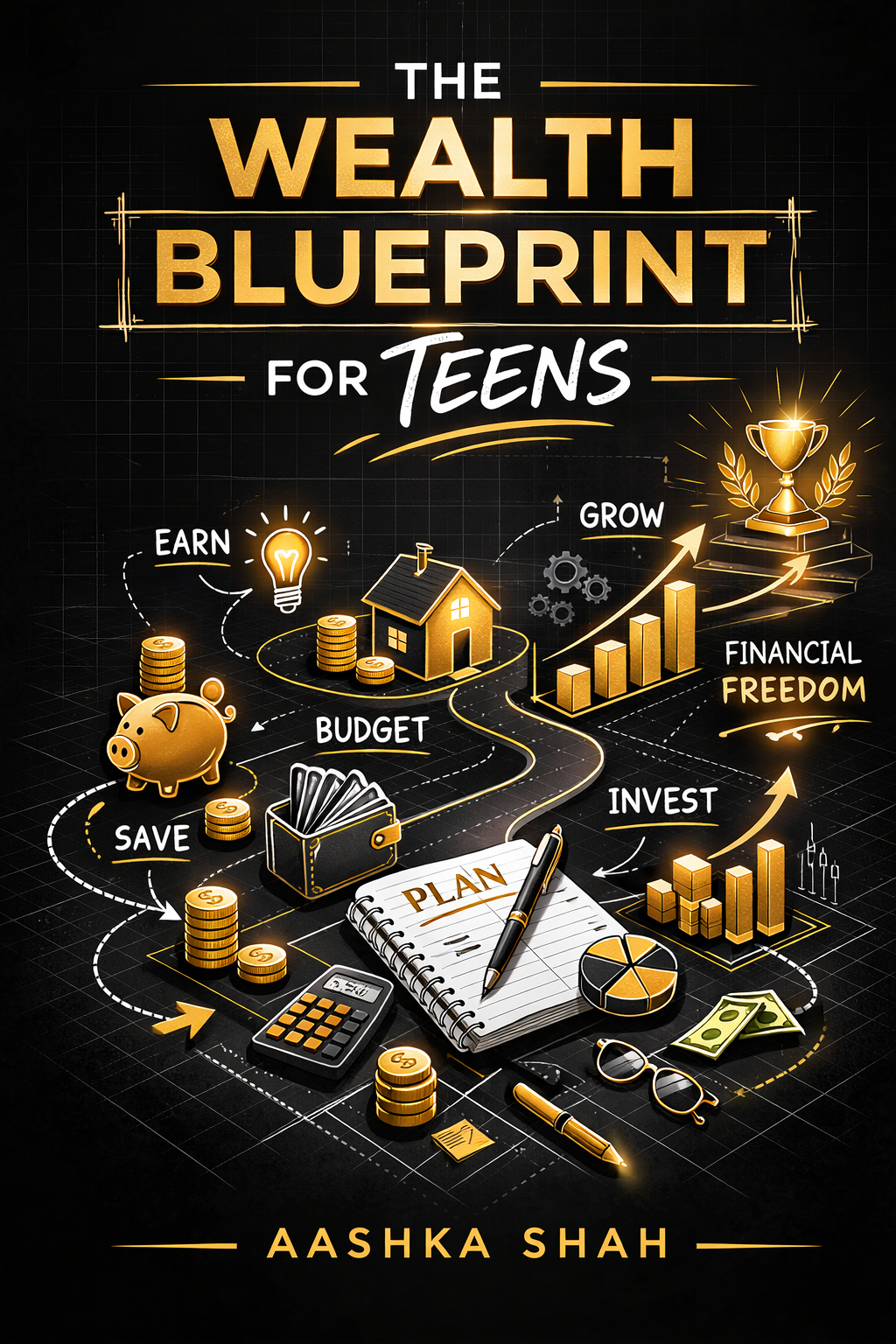
Most money books assume you already have a steady income, a 401(k), and a mortgage. The Financial Blueprint for Teens starts where you actually are: a summer job, an allowance, birthday money, and the very first decisions that will quietly shape every financial decade of your life.
Written by Aashka Shah, a high school student at a STEM academy who learned her first money lesson the hard way (a summer's worth of work reduced to $4.12), this book is the guide she wished had existed for her generation. It's honest, it's practical, and it speaks your language. Not the language of a financial advisor trying to sell you something.
Whether you're 13 or 19, this book meets you where you are. It's also a thoughtful gift for parents who want to give their teen a financial head start before the expensive lessons of early adulthood arrive uninvited.
Every chapter includes a real-life story, a quick pop quiz, and an Action Challenge you can complete that day. By Chapter 10, you haven't just read a finance book. You've actually built your own Personal Finance Plan.
Master budget basics with the 50/30/20 rule and the Envelope Method. You will finally understand why money disappears even when you're not spending big.
Short-term vs. long-term goals, the power of compound interest, and why saving a little now beats saving a lot later. Includes The Tale of Two Taylors.
Needs vs. wants, outsmarting impulse buying, and smart shopping strategies, including the 24-hour rule and how to measure purchases in hours, not dollars.
How banks actually work, the difference between checking, savings, and digital wallets, ATM fee traps to avoid, and how to keep your accounts safe online.
The three ways to earn money: part-time jobs, the gig economy, and entrepreneurship. Plus 2026 business ideas any teen can start this week.
Stocks, bonds, and ETFs explained without jargon. The compound interest snowball. And why The 15-Year Lead means starting now beats doubling your contributions later.
What credit scores actually are, good debt vs. bad debt, the Minimum Payment trap, and how a $20 pizza can quietly cost $150. Essential reading before you turn 18.
The Marshmallow Test, the habit loop, delayed gratification, and the "Save Before You Spend" rule. Why habits beat hustle, every single time.
The Give, Save, Spend system. Why the most financially successful people build giving in from the start, and why it leads to an abundance mindset rather than a scarcity one.
Tie everything together into your own written Personal Finance Plan: goals, a budget, an investing strategy, an accountability partner, and a 90-day action timeline.
Teens are one of the fastest-growing targets for online scams. This bonus section covers the Big Four teen scams: fake job offers, phishing, ticket traps, and fake "free money" DMs. It also gives you a Scam-Proof Checklist so you spot them instantly.
A fill-in-the-blank 50/30/20 budget tracker with categories for needs, wants, and savings, plus space to note one thing you will do differently next month.
Set a specific goal, calculate your weekly save amount, and color in a progress bar as you go. Includes a 90/10 reward milestone so you actually celebrate hitting your goal.
List every subscription and recurring charge you pay. Rate each one: Keep, Share, or Cancel. If the yearly total surprises you, congratulations. You just found your ghost money.
A complete teen-friendly glossary of 35+ financial terms, including APY, ETF, Roth IRA, and Compound Interest, with friendly one-line definitions you will actually remember.
Water fills up when you earn. It drains out when you spend. Overflow means you're saving. Too empty means you're in trouble. Simple, visual, and impossible to forget.
A tiny seed tucked in warm earth grows into a forest over seasons, without you doing anything extra. That's compound interest. One metaphor; the whole concept understood.
Choosing a budget style is like picking your character in a video game. The 50/30/20 Rule and the Envelope Method are both solid. You just have to know which one fits your playstyle.
The famous psychological experiment that predicts financial success. Every purchase decision you make is a marshmallow test. Once you see it that way, you can't unsee it.
Every chapter ends with a real, completable task. Reading about money changes nothing. Doing something changes everything. By the last page, you've accidentally built a complete personal finance plan.
Every chapter uses a short real-world story to make the concept stick. Here's a taste.
Sam felt short on cash despite working weekends. His monthly bank statement told a different story: three streaming services, an unused workout app, a game subscription he'd forgotten about. Sixty dollars vanishing like steam, every single month. Two cancellations later, $300 freed up over a year. Enough for a flight. Or a gaming setup. All it took was hitting unsubscribe twice.
Taylor A saved $20 a week for five years. By the time Taylor B started spending less and saving more, Taylor A already had enough for a reliable used car, paid in full with zero monthly payments. Taylor B needed a loan. Three hundred dollars left their account monthly for years. Five years make a gap you can feel. One Taylor breathed easy; the other moved fast and tense. Timing shaped everything.
Leo bought a $20 pizza on his credit card. He only made the minimum payment of $5. By the time the card was actually paid off, with a 25% interest rate and a late fee, that one meal cost him $150. Was it a good pizza? Maybe. Was it a $150 pizza? Definitely not. This is what happens when you treat a credit card like free money.
Don't wait to feel ready. Don't wait until the amounts feel "worth it." The best time to start is right now, when time is still your biggest advantage.
Get it on Amazon →